
Make One Thing Matter: How to Edit a Busy Painting

A painting can be full of good ideas and still feel strangely empty. A bright window, a detailed tree, a sharp horizon, a dramatic cloud: each one works on its own. Together, they can sound like four instruments playing solos at the same time.
When that happens, my first instinct is to add something. Another highlight. A stronger shadow. One more clever little mark. Usually the painting is asking for the opposite. It needs an editor.

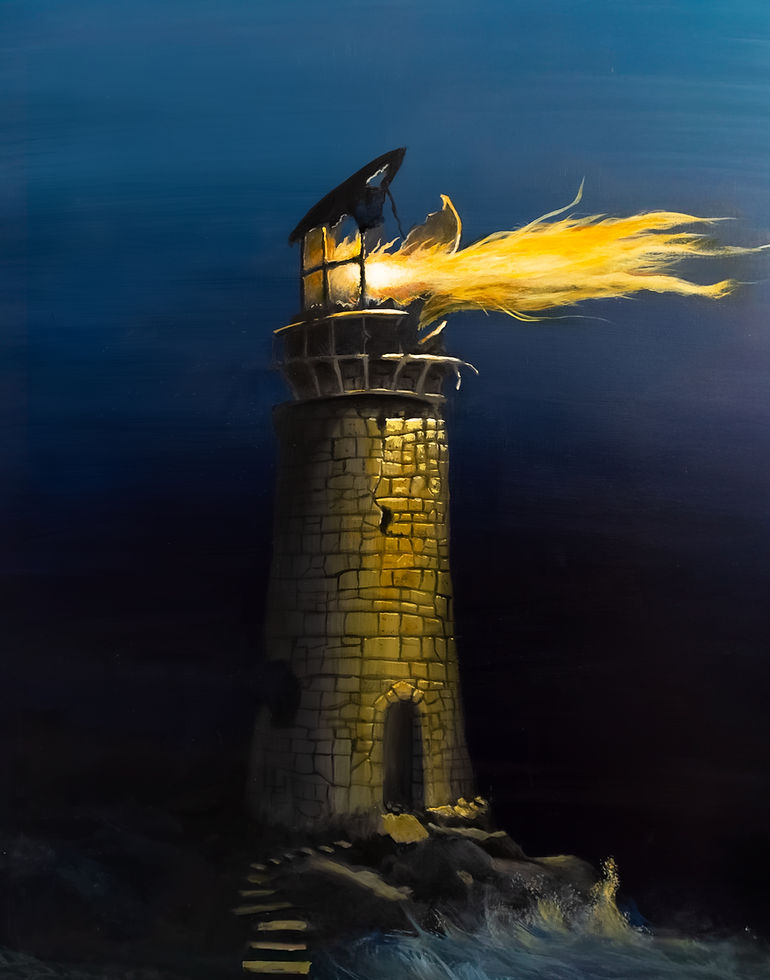
In Lighthouse 2, the gold beam is the first thing your eye catches because the surrounding blue sky and dark water stay quiet. The lit stonework supports that light without demanding the same attention. Imagine every rock, wave, and cloud given an equally sharp edge and bright accent: the beam would have to fight for the room it has now. This is the kind of hierarchy the editing pass is meant to protect.
Find the one thing that matters
Step back far enough that you can no longer admire your brushwork. Ask: where does my eye land first, and where do I want it to land? Those answers should be close. If they aren't, choose a focal area before touching the paint.
That focal area does not have to be the brightest object or sit in the center. It needs the clearest invitation: a useful contrast, an edge, a color relationship, or a group of shapes leading toward it. The rest of the painting can still be beautiful. It just has to know its role.
Make a distraction list
Take a photo and shrink it on your phone until it is thumbnail size. At that scale, small details disappear and the loudest shapes remain. Notice anything that pulls you away from the focal area: a pale corner, a black tree trunk, a saturated patch of red, a row of identical sharp edges.
Write down two or three distractions. Be specific. 'The bright rock in the lower left competes with the lighthouse' gives you a job. 'Something feels off' gives you a very long afternoon.
Quiet the competition
You have several ways to edit without painting over half the canvas. Lower the contrast in the competing area. Move its color closer to its neighbors. Soften one edge. Remove a small highlight. Merge two shapes into one simpler mass. If a mark contributes neither space nor story, it may be collecting rent for no reason.
Try the gentlest change first. In acrylic, test a color on scrap before you cover an area. A thin glaze can quiet a bright passage when the paint beneath is dry, but it will not fix a confused value structure. Sometimes the cleanest answer is a new opaque shape. Let the actual problem choose the tool.
Protect a little mystery
Editing does not mean sanding all the life out of a painting. It means deciding where the viewer gets clarity and where the viewer gets room to imagine. A hard edge against a soft field can feel electric. Ten hard edges spread evenly across the canvas are a committee meeting.
Look at the parts you are most proud of. Is each one helping the whole? That is a brutal question, especially when you spent an hour on a gorgeous bit of texture. Keep it if it strengthens the painting. If it steals the scene, let it go. The viewer will never miss the brushstroke they never saw.
A fifteen-minute editing exercise
Choose a painting that feels busy. Spend three minutes looking at it from across the room, then three minutes looking at a small photo of it. Name the focal area and identify the two loudest distractions. For the next six minutes, change only one of them. Lower a value contrast, soften an edge, or simplify a shape. Use the final three minutes to step away and compare.
If the painting reads more clearly, you have learned which relationship mattered. If it doesn't, you have still ruled out one guess. Either way, stop before the exercise turns into a full-scale rescue operation.
A strong painting does not need every square inch to perform. Give the eye somewhere to go, and give the rest of the canvas permission to breathe. Sometimes the boldest move is the one you take away.
— G.E. Perlin


Comments